
Patching repair to paddock
By now you will be familiar with my perennial complaint about the damage caused by dredging for gold 100 years ago. Its not just whinging, I am trying to do something about it. Different sections are being repaired by me in different ways.
Out in our main paddock about 50% of the area is one massive, spread out dump of dredged spoil. Over time it has generated a miniscule crust of soil, but its essentially 80% river stones. When summer hits the stones heat up and cook anything trying to grow, and by the time we get to February we are looking at bare surfaces. With no cover the soil bakes incredibly hot and nothing can possibly grow. That includes worms and beneficial bacteria. Its a desolate environment.
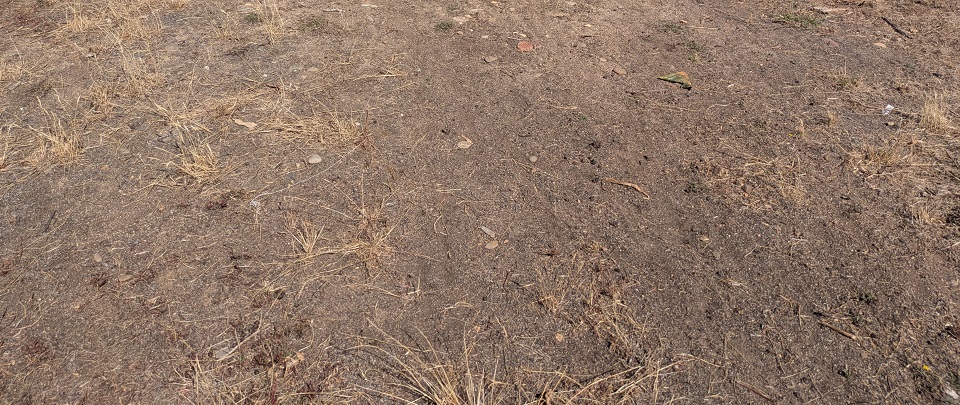
Unimproved mining spoil, Feb 2026, summer-baked bare earth
Its a big area. I can't fix it all in one go, so what I have been doing is building a cover on sections of it. Amongst the organic treasure I collect that I can use in this process are lawnmower clippings, horse manure, autumn leaves, and chaff from the grass seed grower nearby.
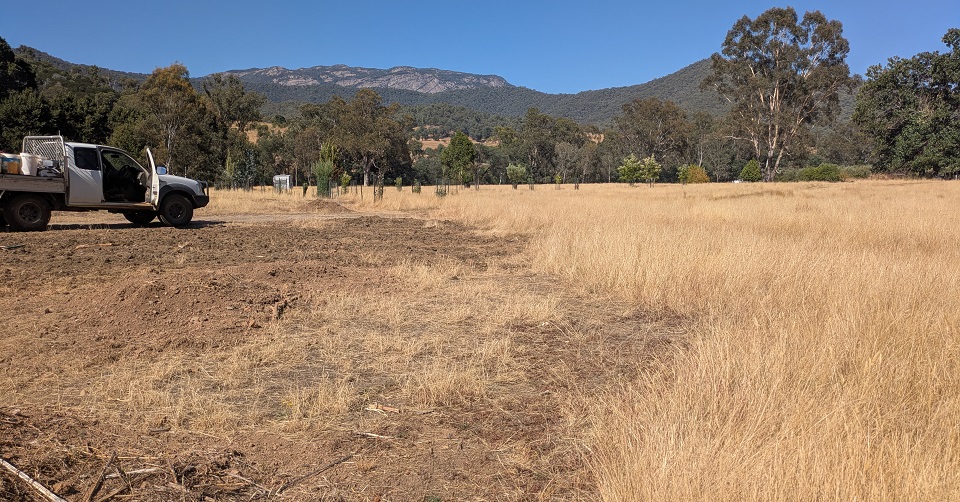
Clear line between mining spoil dumpline and unmined pasture
Here you can see an area that is partially rehabilitated. To the right is grass. It shows the sort of growth we see from basic paddock grasses in soil that has not been directly impacted by mining/dredging. To the left is the mining spoil area. Its quite a distinct line.
This area has been already partially treated. It has had autumn leaves spread over it mid-2025. With no life in the topsoil the leaves were covering there has been little breakdown of the leaves. No worms or bacteria to break it down. In Spring the leaves were covered by grass clippings. I get 240litre wheelie bins full of mown grass clippings. If I get them fresh they are light and easily spread by hand. (If I am too slow to collect the bins, or its unseasonably hot, the grass starts to rot in the bins. If that happens I dump the bins as a rotten blob in another paddock that's full of holes.)
In December we had some earthworks done and finished up with a few cubic metres of soil, and then a neighbour gave away about 5 cubic metres of soil. All of that was added to this area, tipped out and raked into a crust to cover the grass clippings.
There has been little progress over summer. We've had almost no rain for months, and life-killing heat including a week of 38+.
I am being told that we are going to get rain, for at least four days, at the end of the week. So everything kicked into action today and I seeded the area with basic paddock grass seed.
I started up again the weekly collection of horse manure from a nearby farm. Its been so hot the manure had powder-dried, so it readily spread over the top of the grass seed.
Then also today I collected native grass seed chaff from the nearby grass seed farm. Notionally its just straw, but there is a small percentage of remnant viable seed in it. They have just finished harvesting and processing the seed, so there was a LOT of chaff to take away.
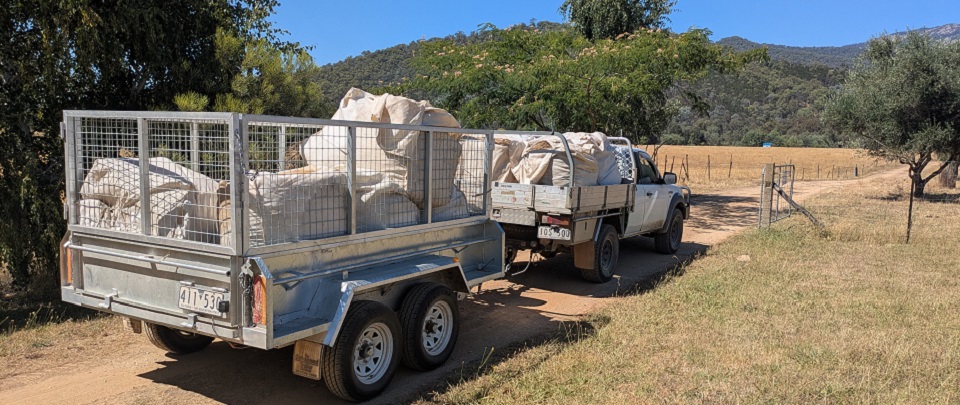
Bags of chaff after grass seed removed
That was spread out over the whole area to give a cover layer. It will help retain some moisture when it rains, and partially hide the seed from birds. And, I have seen from previous efforts, some native grasses will emerge from this chaff.
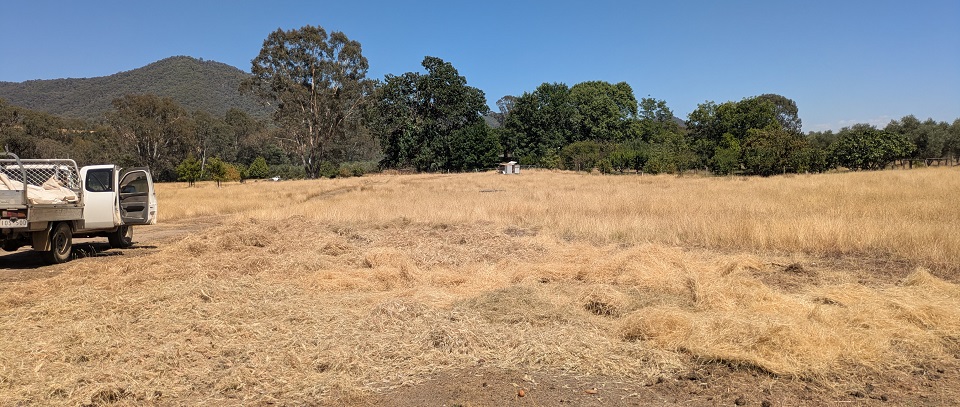
Mulch cover from grass seed chaff
Out of all of this I expect some grass to grow, both commercial paddock grasses and native grasses. We've effectively created about 5 cm of "topsoil" to sit above the original surface to support it. And if that grows the covered soil will do better in summer and the rehabilitation has actually started.
Last year I did a similar process over a different area. Its dry now, but for months it had a grass cover. I am convinced it is working, its just that the timescale is slower than humans can accept!
In the vegetable garden I am cultivating earthworms on a pretty big scale. I haven't put them out into this project yet, as I am sure they would have been sterilized out of existence by the relentless heat we've had the last month. But come autumn, when it cools down I will add some live cultures to this area.